

The short answer: Six months of security findings should drive your funding decisions, not just your remediation plan. Sort every finding by origin: new releases, configuration drift or legacy systems. The biggest pile is the source that keeps refilling your list, and it’s next year’s first budget line. Exploited vulnerabilities started 31% of the breaches Verizon analyzed for its 2026 report.
This applies to any organization closing out a remediation push; we cover it from the buyer’s side, for the CIO, CISO or IT director who owns the security budget.
Your security findings should decide where next year’s money goes, not just what your team fixes next. Exploited vulnerabilities started 31% of the breaches Verizon’s 2026 breach report analyzed, more than any other entry point and up from 20% a year earlier. Fixes are slowing, too: only 26% of known exploited vulnerabilities were fully remediated in 2025, down from 38%. If your team spent the spring and summer closing findings, your CFO’s next question is where the 2027 security money should go. Those findings already hold the answer.
Many teams file six months of findings as a remediation plan, a to-do list to close, instead of reading them as a pattern. Every finding came from somewhere. Some arrive with each release, because security checks sit at the end of the pipeline. Some come from settings that drift after go-live. Some live in old systems nobody wants to touch. Fix them one at a time and the list refills from the same place. You pay for the same repair every quarter.
This guide covers where findings come from and how to sort six months of them by origin. Then it matches each source to its fix, turns the pattern into a budget line, and names what to measure once it’s funded. Every figure comes from CISA, NSA, NIST, the GAO, NACD, Gartner or Verizon’s annual breach study.
Where Do Your Security Findings Actually Come From?
We sort them into three sources: new releases, configuration that drifts after go-live, and legacy systems that can’t take a patch on time. Each source needs a different fix. NSA and CISA’s 2023 advisory lists default configurations first among ten common misconfigurations, in a non-prioritized list. Misconfiguration is a pattern, not a one-off.
That advisory came out of NSA and CISA red and blue team assessments, plus hunt and incident response work. Its finding should worry any IT leader with a mature program. The ten misconfigurations point to “a trend of systemic weaknesses in many large organizations, including those with mature cyber postures.” A mature program is no guarantee against them.
NIST pushes the same way from the software side. Its Secure Software Development Framework, published in 2022, asks producers to “address the root causes of vulnerabilities to prevent future recurrences.” Root cause isn’t a nice extra. It’s written into the framework as a practice.
So the misconception to retire is this: a closed finding is a solved problem. It isn’t, if the thing that created it is still running. A scan tells you what’s open today. It doesn’t tell you why. That’s why the assessment isn’t the deliverable. The pattern behind it is.
Sort Six Months of Findings by Origin
Tag every finding from the last two quarters as release, drift or legacy, then count each pile. The system and the date usually settle the tag. Federal rules already sort by age: CISA’s BOD 22-01 gives federal agencies six months for known exploited vulnerabilities with pre-2021 CVE IDs and two weeks for newer ones.
1. Release findings: new with each deployment
These show up right after something ships: new code, a new container image, a new service. The counterintuitive part is that they look like a developer problem. They’re a pipeline problem. If checks run only at the end, every release delivers a fresh batch. That’s the case for building security into every release instead of testing it in afterward.
2. Drift findings: right at go-live, wrong now
A setting passed review at launch. Six months later it doesn’t. Somebody opened a port for a test, or an update reset a default. Most vulnerability scanners don’t label a finding as drift. You have to look for it. Here’s the tell: a finding that reopens after you closed it is almost always drift. Count the reopens separately.
3. Legacy findings: old systems, old flaws
These are the same old vulnerabilities on systems that can’t take the patch, or that nobody will risk patching. Federal rules follow the same logic of age: BOD 22-01, in force since 2021, gives federal agencies a longer clock for known exploited vulnerabilities with CVE IDs assigned before 2021. Keeping existing systems running is expensive, too. The GAO says federal agencies typically report spending about 80% of their IT money on operating and maintaining existing IT, out of more than $100 billion a year.
Tag last quarter’s findings by origin: release, drift or legacy. As a rule of thumb, no source should hold over half the list. If one does, fund that source, or your budget keeps paying for repairs. Want a second read on your split? Compare notes with us
Release Findings Versus Drift Findings: Two Different Fixes
Release findings get fixed upstream, in the pipeline, before code ships. Drift findings get fixed downstream, with a written baseline and a check that runs after go-live. Patching each one by hand fixes neither source. NIST defines patch management as five activities, ending with verifying. A verify step that rechecks settings, not just patches, is where drift shows up.
The table below matches each origin to the fix that stops it refilling, and to the budget line that pays for it.
| Origin | What it looks like | The fix that stops the source | The budget line |
| Release | New findings after each deployment | Security checks earlier in the pipeline | Pipeline tooling and engineering time |
| Drift | Settings that passed at launch and fail later; reopened findings | A documented baseline plus scheduled configuration checks | Configuration management and monitoring |
| Legacy | The same old CVEs on systems that can’t take the patch | Replace, isolate or retire on a dated plan | Modernization, not maintenance |
Why does fixing the source beat fixing the finding? Because a patch lowers the count once, while a source fix lowers the inflow for good. NIST’s patch management guide, published in 2022, frames patching as “a critical component of preventive maintenance.” Prevention is the point. A team that closes drift findings every quarter and never sets a baseline will close the same ones again next quarter.
The same logic works for legacy, with a twist. You can’t pipeline your way out of an unsupported system. The fix is a date: replace it, wall it off from the rest of the network, or retire it. A system with no date stays on the remediation list forever.
The offensive play: fund the biggest pile, not the scariest single finding. One critical flaw gets fixed this week either way. The pile is what eats next year’s hours, and it’s where our guide to remediation after a scan starts too.
How Do You Turn a Finding Pattern Into a Budget Line?
Name the source, price the fix that shuts it, and set a target for the count. NACD’s 2026 handbook says strong budget reviews link spending to measurable reductions in risk. Only 10% of non-executive directors in a Gartner survey expressed strong confidence in the value of their security investments. A line tied to a source gives them something to check.
That Gartner survey, published in November 2025, asked 330 non-executive directors worldwide. Ninety percent lacked a measure of confidence in cybersecurity value. Spending keeps climbing anyway: Gartner forecasts worldwide security spending will rise 12.5% in 2026, to $240 billion. More money isn’t the hard part. Aiming it is.
Three steps turn your findings into a request a board can check:
- Lead with the biggest source. Put its share of the last six months’ findings in the first line of the request. A line like “drift produced most of our findings this year” is one a director can test.
- Price the source fix, not the backlog. Engineering time for the pipeline, a configuration baseline and the tooling to check it, or a retirement date with its cost. The backlog still gets worked. It just stops setting the budget.
- Write the target into the plan. Say what the funded source’s count should do by the end of the next quarter, and when you’ll report it.
Automate the timing, never the human moment. Rescans and configuration checks belong on a schedule. The call to retire a system, delay a release or accept a risk belongs to a person who can answer for it. Federal agencies work to fixed clocks under BOD 22-01; your clock is the one you write into the plan.
A request built this way is also what board-level cybersecurity governance now asks for. It ties money to a change the board can see, in the spirit of NIST’s CSF 2.0 Govern function.
Which line in your 2027 security budget shrinks a source of findings? Check each one. Every line should name the source it shuts. A line that only buys more scanning pays to find the same gaps again. Can’t name the source? Let’s talk it through
What to Measure in the First Quarter After You Fund It
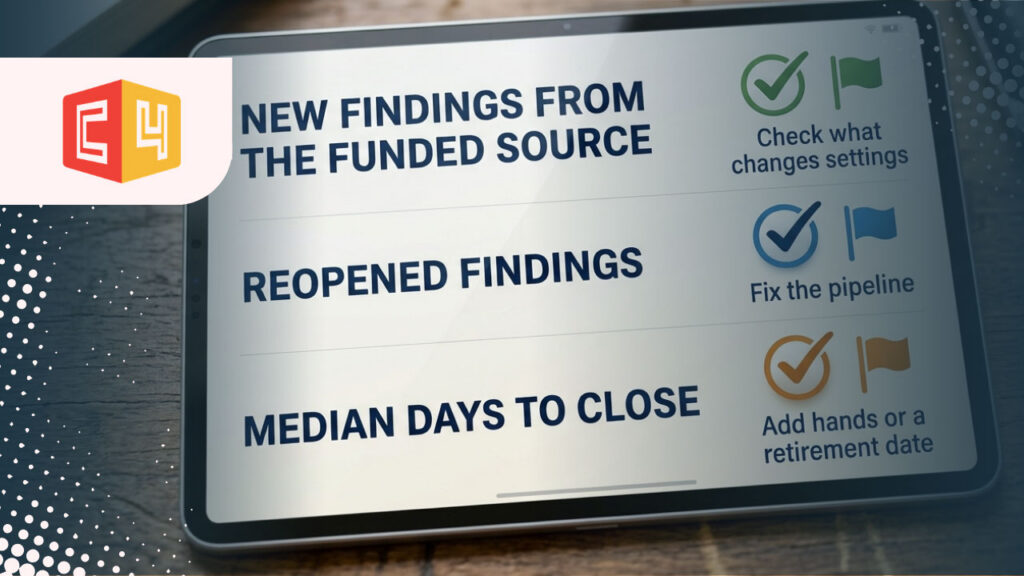
Track three numbers from the first quarter: new findings from the funded source, findings that reopen after closure, and median days to close. Your own median is the one that counts. Take your baseline before the money lands. Without one, nobody can say whether the fix worked.
- New findings from the funded source. Count them each month. They should fall quarter over quarter. Flat means the fix hasn’t reached the source yet.
- Reopened findings. Count findings that came back after closure. The target is a falling number, heading toward zero. Every reopen is drift you paid to fix twice.
- Median days to close. Measure it for the findings that remain. It should hold or shrink while the inflow falls.
These targets are a rule of thumb, not a benchmark. The diagnosis comes from reading them together. If new findings fall but reopens don’t, the source fix works and the baseline doesn’t: check what changes settings after go-live. If reopens fall but new findings don’t, drift is handled and the pipeline is still leaking. If both fall but days to close rise, the remaining backlog needs hands or a retirement date.
NACD’s handbook asks whether board reporting includes “trendlines across quarters and years to identify emerging patterns.” These three numbers are that trendline. They also give your next audit-readiness check a record to start from.
Frequently Asked Questions
What is configuration drift in cybersecurity?
Configuration drift is the gap that opens between a system’s approved settings and its current settings over time. It comes from manual changes, updates that reset defaults, and quick fixes nobody reverses. It matters because a system can pass review at launch and fail months later without anyone touching the original design.
How much should a mid-size company spend on cybersecurity?
We found no reliable public benchmark by company size, so budget by risk instead. Start with the sources producing most of your findings, price the fixes that shut them, then add ongoing monitoring. A budget built from last year’s number plus inflation tends to fund the same repairs again.
What is the difference between a vulnerability and a misconfiguration?
A vulnerability is a flaw in software or hardware that an attacker can exploit, usually fixed with a patch from the vendor. A misconfiguration is a setting your team chose or left in place, such as a default password or an open port. You fix it by changing the setting, so no vendor patch is coming.
How often should you retest after remediation?
Retest each fix once it’s applied, then again at your next scheduled scan to confirm it stayed fixed. NIST’s patch management guide treats verifying as its own step, after installing. A finding closed without a retest is a claim, not evidence.
Who should own vulnerability management in a mid-size company?
One security leader should own the program and its numbers, usually the CISO or the IT director who carries security. Each system also needs a named owner who answers for its fixes. When ownership sits with everyone, findings sit with no one.
Fund the Source, Not the Repair
Thirty-one percent of the breaches in Verizon’s 2026 analysis started with an exploited vulnerability, and only 26% of known exploited vulnerabilities were fully remediated in 2025. Remediation is slipping. The way back is to read six months of findings by origin, fund the biggest source, and measure whether it shrinks.
The budget, the risk calls and the board conversation are yours. Fixing the gaps, not just finding them, is what C4 Technical Services’ cybersecurity consultants deliver, with the same experts from scoping to delivery. Our Board-Ready Security Report puts that work in front of your board as a risk register and a 12-month remediation roadmap. If you’re writing the 2027 security plan now, start with your findings.
References
- “2026 Data Breach Investigations Report.” Verizon Business, global dataset of more than 22,000 confirmed breaches. Published May 19, 2026. Verified live October 20, 2026.
- “NSA and CISA Red and Blue Teams Share Top Ten Cybersecurity Misconfigurations.” NSA and CISA, joint cybersecurity advisory AA23-278A. Published October 5, 2023 (2023 advisory, framed as such). Verified live October 20, 2026.
- “Secure Software Development Framework (SSDF) Version 1.1, SP 800-218.” NIST. Published February 3, 2022 (current version, framed as 2022 in the passage). Verified live October 20, 2026.
- “Guide to Enterprise Patch Management Planning, SP 800-40 Rev. 4.” NIST. Published April 6, 2022 (current revision, framed as 2022 in the passage). Verified live October 20, 2026.
- “Binding Operational Directive 22-01: Reducing the Significant Risk of Known Exploited Vulnerabilities.” CISA, applies to federal executive branch agencies. Published November 3, 2021 (directive in force, framed as federal rules). Verified live October 20, 2026.
- “Information Technology: Agencies Need to Plan for Modernizing Critical Decades-Old Legacy Systems,” GAO-25-107795. US Government Accountability Office. Published July 17, 2025. Verified live October 20, 2026.
- “Principle 5: Guide Cybersecurity Risk Measurement and Reporting.” National Association of Corporate Directors, Director’s Handbook on Cyber-Risk Oversight 2026. Published April 15, 2026. Verified live October 20, 2026.
- “Gartner Survey Finds 90 Percent of Non-Executive Directors Lack a Measure of Confidence in Cybersecurity Value.” Gartner, survey of 330 non-executive directors in four regions, fielded April to May 2025. Published November 24, 2025. Verified live October 20, 2026.
- “Gartner Forecasts Worldwide End-User Spending on Information Security to Total $213 Billion in 2025.” Gartner. Published July 29, 2025. Verified live October 20, 2026.
